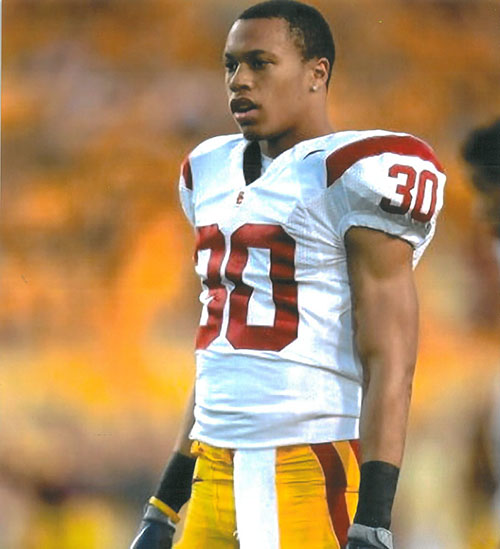
Brian Baucham playing at USC
Saturday, September 22nd 2012 was a USC game night like any other. A sea of red and gold bodies packed into the Coliseum, hungry for a win against Cal.
Brian Baucham ran out of the tunnel onto the field with the rest of his teammates as 83,421 people cheered from the stands. A moment of glory that quickly transpired. It was Baucham’s last game he’d ever play as a trojan.
USC’s football team has long been the pride and joy of the university. A symbol of what it means to be a Trojan and to “fight on” until you achieve victory. It’s what unifies students, alumni, and teachers once a week when we all want the same thing; to watch USC win. However, with this modern day gladiator sport comes injuries and health problems that last long after game day.
The September 22nd game vs. Cal state seemed to be going great for the Trojans. The game was coming to a close and USC was winning. This was right around the time Brian Baucham collapsed on the sidelines.
Brian was rushed to the USC health center where they discovered swelling in his lungs and bleeding in his brain. Brian was hooked up to a ventilator for two days until he was able to breathe normally on his own.
Nearly two years to the exact day of his final game, Baucham has filed a lawsuit against the University of California and his former coach, Lane Kiffin. Baucham and his attorney claim the coaching staff and university acted negligently by making Baucham play the game despite him being ill.
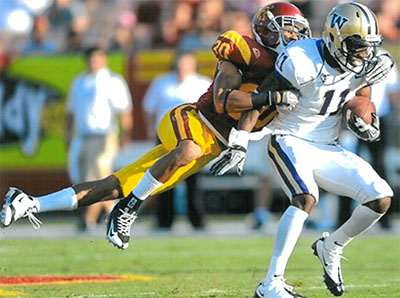
Brian Baucham (left)
According to Baucham’s attorney, Bruce Brusavich, Brian went to USC medical center the day prior to the game against Cal where they documented he had a fever of 103, abdominal pain, headache, and nausea.
Brusavich claims that coach Kiffin was well aware of Brian’s illness.“The morning of the game Brian told the coaches he was just too sick to play” says Brusavich. “They told him to suit up and get on the field, and they played him even though he was too sick and really too weak”.
“He didn’t make it through the 1st quarter” says the attorney. According to Brusavich, Brian was then brought into the locker room where he was given another IV.
“He tells me today he doesn’t really remember coming out of the tunnel, but they put him back in the game during the 3rd quarter” Says Brusavich. “finally he just collapsed on the sidelines”.
Brusavich claims that Brian was given too much intervenes fluids to try to flush out his virus. “His body overloaded on the fluid. It really had nowhere to go except first in his lungs, which made it impossible for him to breathe and that fluid overload contributed to what caused the bleeding in his brain”.
Former USC student and football player Bob DeMars understands the highs and lows of being a college athlete. Demars played for the Trojans from 1997-2001 where he says he had a great experience overall. DeMars recently made the documentary, “The Business of Amateurs” that examines the role of the NCAA and student athlete’s rights.
DeMars expresses his love for USC and feels his health was well taken care of by the coaching and medical staff. However, he believes there are issues within college football at every university that should be addressed.
“there’s no intermediary. there’s nobody thats acting on the players behalf in some scenarios, to step in and ask, okay is this too much. Because players are very prideful. players are gonna play if the coach says go out there”. DeMars explains. “You make an excuse all the sudden there’s politics involved and it’s like okay maybe this kid doesn’t want it enough”.
This echoes a point made by Dr.Vernon Williams, a sports neurologist at Kerlan-Jobe Center for Sports Neurology. Dr.Williams recalls a recent conversation he had with an NFL coach. “He said ‘If a player of mine was out from a concussion I would kind of look at them sideways and go you’re walking and talking and we got people behind you who’d love your spot’”. This NFL coach explained he used to view players who said they couldn’t play as not committed to the team and to their position. Dr.Williams is happy to say that this coach along with many others now thinks differently.
Brian Baucham’s injuries on September 22nd followed a concussion he sustained about 2 months earlier.“It’s not unusual to put a student back in a month or two months after a concussion if he clears” says Brusavich. “Whats very unusual is to have a student athlete who is so ill that the student says ‘coach i’m too sick to play. That sends up a red flag, and a coach really has to pay attention to that”
While DeMars says he never saw players be pushed to play against their will during his time at USC, he recognizes this is an issue that occurs in college football.
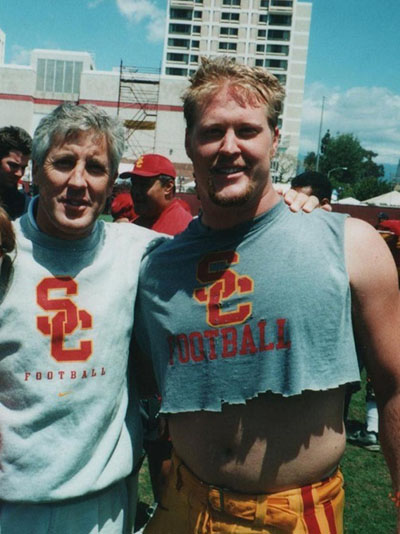
Bob DeMars and coach Pete Carroll
DeMars recalls the 2011 death of college football player, Derek Sheely. During practice, Sheely told his coach he was suffering from a headache when his coach allegedly expressed that he needed to man up and keep playing. A wound on Sheely’s head reopened, causing him fatal brain trauma.
Brusavich claims that Brian is still suffering from the injuries he sustained during his USC football career. “He suffers from all the classic symptoms of post traumatic brain injury” says Brusavich.
While Dr. Williams says the risk of concussions will never be eliminated from football, so that coaches and medical staff “need to continue to monitor and surveil players as much as possible”.
Bob DeMars feels that while players need to understand the risks of playing the sport, long-term brain damage is something “nobody signs up for”.
DeMars says USC is above the curve in many ways when it comes to the protection they give their players. However, he wants to see them change within their athletic policies regarding the health of former athletes.“I’m hoping that USC can be one of the first schools to make a public commitment to the athletes. Because I already know they help guys behind the scenes” says DeMars. “I think they’re not public about it because all these head injuries have created a lot of questions… And there’s a lot of unknowns right now”.
http://buckeyextra.dispatch.com/content/stories/2014/10/02/ncaa-notified-of-leagues-reforms.html
Baucham’s attorney says their main concern is making sure Brian’s longterm health is taken care of. “These young athletes should not be sacrificing their whole life for a game”, says Brusavich.
USC athletic director Pat Hayden released a statement following the announcement of Baucham’s lawsuit stating, " I will say that I am confident that we provide excellent medical treatment to our student athletes and that their health is always our primary concern ahead of any athletic competition.”
With the recent deaths of 3 high school football players happening within 7 days of each other, the health of student athletes continues to be a controversial topic that has many questioning the risks of the sport.
http://www.forbes.com/sites/rogergroves/2014/10/04/the-underpublicized-high-school-football-deaths/
The one thing that everyone can agree on; this sport isn’t going anywhere anytime soon.